The laser at work,
step by step.
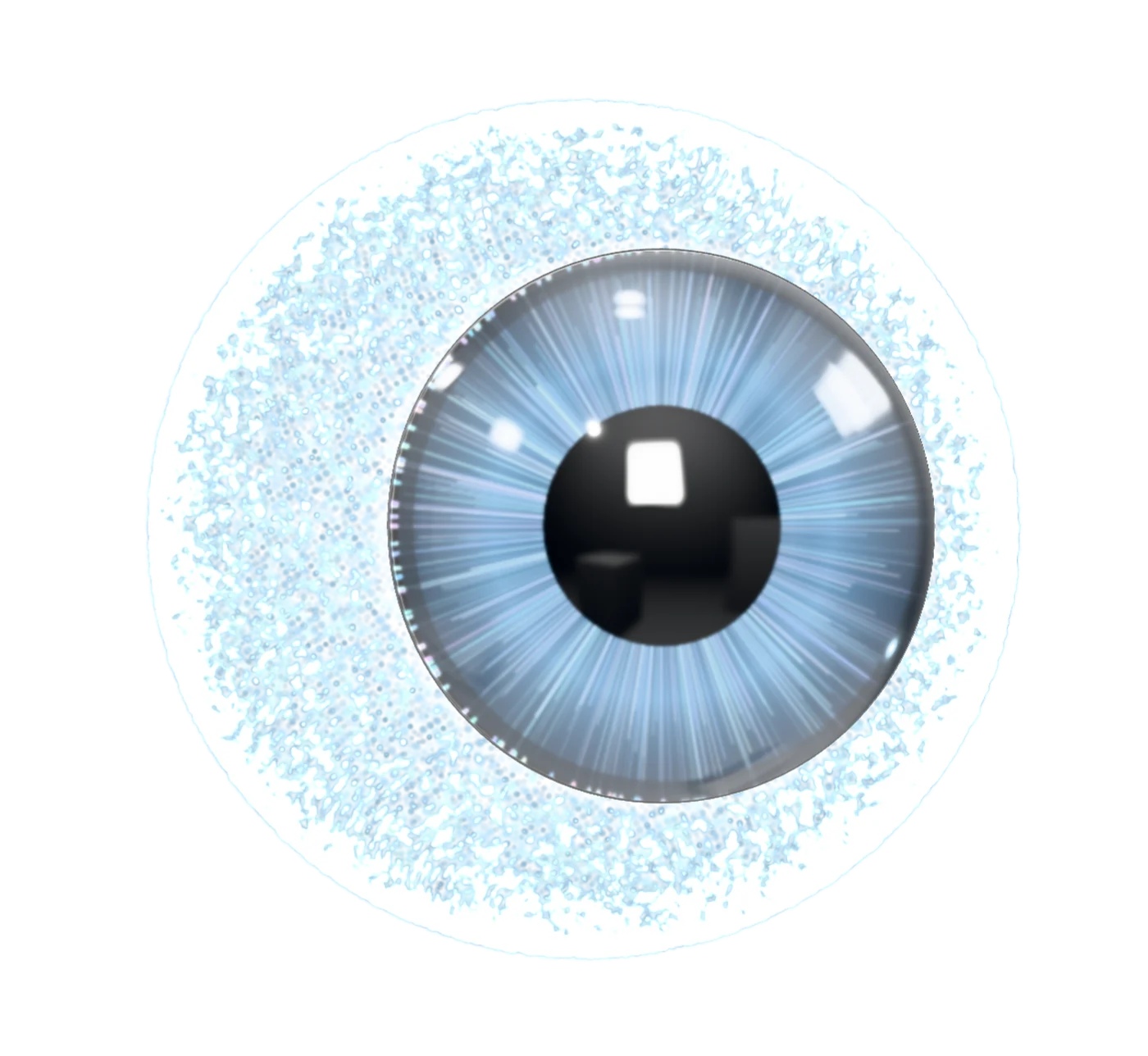
Fovea is the demo website of a fictional laser eye surgery practice (refractive surgery) in Hamburg. Its look follows a high-tech reference: a dark page, the name across the full width and, in front of it, the eye as a sphere of light points with a glass cornea that refracts the letters behind it. On the page “Der Laser bei der Arbeit” three procedures run step by step on the cut-open eye.
A demo, not a client
Fovea is not a real practice and has no patients, so we publish no outcome figures for it. Like our other demos, every page carries the bar “Demo-Website von FIB Consulting · fiktive Praxis”, search engines do not index it, and the legal notice names the actual operator, FIB Consulting. The address, Beispielkai 5 in Hamburg, is fictional, and the phone number comes from a range that the Bundesnetzagentur, Germany's telecoms regulator, reserves for media productions, so it is assigned to no one. The name comes from the fovea, the small pit in the retina where vision is sharpest.
A dark page and an eye of light
The reference was a sphere of particles behind a headline. On Fovea the sphere is the eye: 26,000 light points form the globe, with a glass cornea at the front and the iris and pupil behind it. The cornea refracts the name in the background, and every few seconds a scan line sweeps over the eye and the points light up where it passes. The eye turns towards the pointer in small saccades; if the visitor's system is set to reduced motion, it stays still. The page is dark on every device, with cyan and violet accents; the cards, the risk figures and the step panel on the laser page are made of liquid glass. The text is set in Space Grotesk, the labels in JetBrains Mono, both under the SIL Open Font License and served from our own server. No serif and no italics in headings, so everything reads easily.
Three procedures on the model
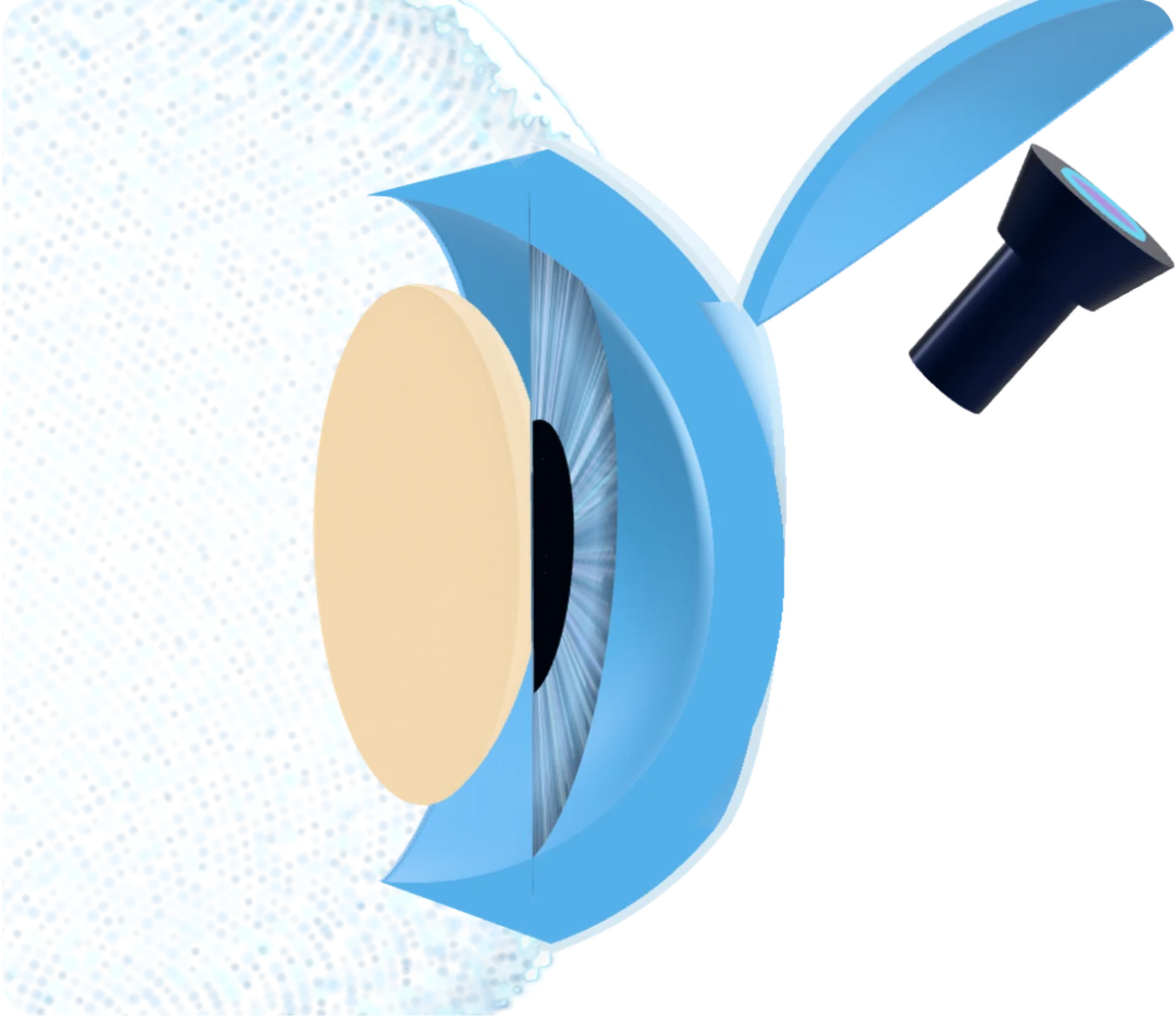
On the page “Der Laser bei der Arbeit” the eye is cut open and seen from the side, so that you look into the cornea; layers and cuts are drawn much thicker than they are, and the page says so. Three procedures run on the model, each step by step. Femto-LASIK in four steps: the femtosecond laser cuts the flap with thousands of tiny gas bubbles about 0.1 mm under the surface, the flap is lifted, the excimer laser removes tissue pulse by pulse in the 6-mm zone, about 12 thousandths of a millimetre per dioptre, and the flap is laid back without a stitch. SMILE in three steps: two cut surfaces inside the cornea enclose a lenticule, a 2 to 4 mm incision is made at the edge and the lenticule is removed through it. trans-PRK in three steps: the laser removes the epithelium, reshapes the surface of the cornea without a cut, and a bandage contact lens protects the eye until the epithelium has grown back in three to five days. Clicking a step takes the model straight to it, “Noch einmal abspielen” replays the procedure, and below the model each procedure is also written out in words. Without a capable graphics chip the panel shows a still image per procedure and works the same way.
Facts with sources
Eligibility follows the recommendations of the German Commission for Refractive Surgery (Kommission Refraktive Chirurgie, KRC) of May 2024, shown as a table with the recommended range and the limit range in brackets: myopia to −8 dioptres for Femto-LASIK and SMILE and to −6 for trans-PRK, hyperopia to +3 for Femto-LASIK, for trans-PRK only in the limit range and not rated for SMILE, astigmatism to 5 dioptres. At least 18 years old and a prescription stable for one to two years; the cornea not under 480 µm for Femto-LASIK and at least 250 µm left after the ablation; no contact lenses before the examination.
Four appointments, with the informed-consent discussion on a day of its own (§ 630e BGB); the Federal Court of Justice ruled in 2022 that the law sets no fixed waiting period, and the practice leaves time anyway. For the risks, the site gives figures from studies: in the PROWL studies 28% of previously symptom-free patients reported dry eyes three months after LASIK and about 45% new visual phenomena such as halos; 6% of eyes needed an enhancement in a ten-year study; ectasia after LASIK about 1 in 1,000 eyes, infections 3 to 5 in 10,000.
Costs: statutory insurance does not pay as a rule, private insurers decide according to the policy (BGH 2017), 1,000 to 3,000 euros per eye as a rough guide, and the price in text form after the preliminary examination and before the procedure (§ 630c BGB). The site leaves out what the German law on advertising in healthcare (Heilmittelwerbegesetz, HWG) forbids or restricts: patient testimonials, prize draws and guarantees of success. Before-and-after pictures are left out too, as a precaution, because it is not settled whether the ban on them for cosmetic surgery also covers laser eye surgery. Presbyopia from about 45 comes with or without a laser, and the eligibility page says so plainly. The pages list their sources at the foot, 34 in all.
Booking that ends with a ticket
Patients choose the reason (a consultation, the preliminary examination, the informed-consent discussion or a check-up), then the day and the time, and leave only a name and a phone number or e-mail; the form asks them not to enter their prescription, findings or illnesses. The confirmation is a holographic ticket in Fovea's cyan and violet whose stub tears off, by dragging it or with a button, into a calendar entry with a neutral title and without the reason for the visit. In the demo nothing is sent.
The same standard as the live sites
Fovea has the same foundation as our other websites: a closure notice worded like the sign on the practice door (here because of further training), opening hours with a live status and forms without health data. Without a capable graphics chip the cover and the laser page show still images with the same texts. The site sets no cookies and does no visitor tracking, and the automated accessibility check (axe) finds no errors on the pages. Laser eye surgery is a planned procedure, not emergency medicine, so for emergencies the pages point to the eye emergency department of a hospital and the out-of-hours medical service on 116 117.
Try it (in German): Fovea · the laser at work · eligibility · booking with the ticket.
Planning a website for your practice? See what our websites for doctors include, or get in touch.
A website that explains more than text.
Clear, factual and within the rules for healthcare advertising. Tell us what your practice needs.
Get in touch →